
The blessed divine on Mount Kasios

65c0454321c4937933265491692873fa

Mount Kasios, known as Jebel al-ʾAqraʿ (جبل الأقرع‎‎) in modern Arabic, is known to be a sacred mountain in Syria that hosts great divine power. It has been recognized by many names- such as Mount Hazzi by the Hurrians and Mount Sapan by the Canaanites. The sacred site can be understood as a “Mount Olympus of the Near East,” and in ancient times it was considered a sacred home of the storm deity Baʿal Zaphon, known to the Hellenes as Zeus Kasios, and His sister ʿAnat along with the other deities. In mythology, it is this location where a great battle between Zeus Kasios and a sea-serpent entity identified by the Greeks as the monster Typhon took place. The temple of Zeus Kasios was described as being “dark with clouds,” and the deity is described to appear as a dark-bearded figure.

The site is known for many miracles. On 114/115 ACE Emperor Trajan was spared from a catastrophic earthquake that struck Antioch and gave great offerings to the God as thanks. On 129 ACE Emperor Hadrian climbed the mountain in the darkness of night to witness the dawn at its summit. As he prepared to honor the God with a sacrifice, a lightning bolt at the peak flashed and killed both the animal victim as well as the attendant who was about to slaughter it. Emperor Julian also experienced the deity, however in a much more personal experience.

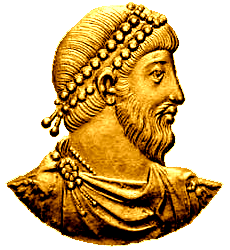
On spring of 363 ACE, the divine Emperor Julian took the route to Mount Kasios to bear witness to the early dawn and give worship and provide a sacrifice to Zeus. The sun rose, and in broad daylight, it is written by Libanius that Julian received an epiphanic vision from the God, and “saw the God and after seeing him… received advice” (Libanius, Or.18.172). It is here that Zeus, “[as] one of the immortals descended from heaven, took [Julian] by the hair, spoke to him, and after listening to [Zeus’] answer [Julian] departed” (Libanius, Or.18.172)


Bibliography

Brown, John Pairman. Israel and Hellas: Vol. 3 : The legacy of Iranian imperialism and the individual. Berlin: W. de Gruyter, 2001.

Fox, Robin Lane. Travelling Heroes: In the Epic Age of Homer. New York: Vintage Books, 2010.

Kalleres, Dayna S. “A City of Religious Pluralism and Spiritual Ambiguity.” City of Demons, 2014, 25-50. doi:10.1525/california/9780520276475.003.0001.

Libanius. Selected works: The Julianic orations. Cambridge: Harvard University Press, 1987.

Posted in Uncategorized | 2 Comments

Reconstructionism Q&A

image

Q: What is Reconstructionism?

A: A rigid and strictly historically informed methodology of reconstructing the practices and world view of the past. It is revivalism of the cultures of the European-Mediterranean cultural basin. It essentially means doing your homework for the practices you’re trying to emulate.


Q: What are the beliefs of reconstructionism?

A: Reconstructionism is merely the methodology of practice; not a form of belief. It’s not a “denomination”, and it has little to do with actual belief.  Reconstructionism is a tool; not a religion.


Q: Does reconstructionism ignore the cultural differences of the past and now?

A: Reconstructionism isn’t ignoring the cultural differences between now and antiquity, nor is it trying to live like it’s the Iron Age, nor is it even practicing the precise religion of the Iron Age. It isn’t disregarding modern ethics and values.


Q: Does reconstructionism mean spiritual stagnation?

A: No. The religions that reconstructionists follow, if practiced, will be living religions. This means there will be change and adaptation, and with that spiritual progression.


Q: Why use Reconstructionist methodology in the first place if the cultures that are being reconstructed are basically dead religions? What’s the point?

A: The cultures that reconstructionist polytheist Pagans seek the emulate may be dead, but that doesn’t mean there’s isn’t any value in their philosophical world view, nor does it mean that their understanding is somehow less valuable than those that survived destruction at the hands of evangelism, proselytization and prosecution. These questions heavily display blatant ethnocentric snobbery. The idea that what we have now, the violent Protestant overculture that has stripped the world of its resources and created a system of consumerist hyper-commodification, is somehow “better” or “more acceptable” than the traditions of our ancestors is nothing more than self-indulgent pomposity.


(Special thanks to /r/Pagan for assisting with making this)
Posted in Uncategorized | Tagged , , , , | 1 Comment
