Against the Monotheists “Occam’s Razor”

CsOunkvVIAALAYq

Often, monotheists will end up invoking Occam’s Razor, a theory at its most basic principle summed up as “the simplest theory is most likely to be correct,” as a defense for their belief (or lack thereof) and as an attack against polytheism. Here I shall dissect their use of Occam’s Razor to show that monotheism is not “simpler” or “more likely” than polytheism in any way, but rather the opposite.


Through reason

Firstly, Occam’s Razor at its most basic principle is “all things being equal, the simplest theory is better”… But all things are not equal. With polytheism, there is more power in the theory, as it has more explanatory and predictive power.

  • Polytheism is more functional as a different deity means a different approach to life, and thus you may not have a guarantee of favor with all of the Gods based on your relation with them. You may be brilliant in economic ventures due to having a secure relation with Hermes, but you might find yourself poor at martial skills due to not having as strong of a relation with Ares.
  • Despite being faced with diverse human religious experience globally that would indicate multiple deities, monotheism ignores this and enforces a belief in only one God, which invalidates the religious experience of others by denying theirs. This makes monotheism require special bargaining because of its atheism which requires one to accept evidence that supports their conclusion but reject any that doesn’t. As such, monotheism has no weight because it claims other Gods do not exist or are merely demons due to its atheistic tendencies which creates a negative inference. A polytheist, however, can use the theory of pragmatic truth and see all religious experience as true, since proper polytheists believe all divinity and thus accept all religious experience. Polytheism thus best accounts for religious experience by abductive reasoning, as the polytheist explanation is less ad hoc and has more explanatory and predictability power.
    • Occam’s Razor says that “entities are not to be multiplied beyond necessity,” however, tolerance of diversity is a necessity. Accepting the existence of all divinities gives a stronger explanation of the great diversity in the world. If creation were only shaped by one deity, then all created things would be identical, and no great diversity would exist in the world. Rather, there is a great plurality and diversity throughout the world between humans, animals, cultures, languages, and morality, which proves that different Gods shaped different beings.
    • The case for a plurality of worship is further seen with Platonism, a polytheistic philosophy, as endorsed by the philosopher Iamblichus. Iamblichus states that the Gods are monoeides, meaning “in the form of singularity,” a term that Plato uses for the Good. This means that the Gods have a singular divine essence first, before they are individuals, as unity preceeds multiplicity. This makes the Gods more unitary and emanatory as manifestations of their divine source, functioning as horizontal extensions of the same power which ultimately leads back to that unity. This singular divine essence gives support to the plurality of worship, as it means there are many ways to approach and worship the divine.


Through definition

The claim that one God is simpler is, in itself, inaccurate. It can be easily countered.

  • A single God by definition is not more likely, as a single God would still be unavoidably complex and beyond the realm of the mind, and thus as likely as a more numerous amount of Gods. Due to this, a single God would thus be on the same footing as a numerous amount of Gods, since a single God is already unavoidably complex in nature. Gods are not simple; a deity’s existence isn’t tied to the human mind’s ability to wrap itself around that existence.
    • One may try to counter this by claiming that there is only one God who “absorbs all” or that all the Gods “are an aspect of one,” however this is still polytheism in itself since you are imposing dualism by splitting divinity. When you split divinity, you merely make “God” a class term, which polytheists have always understood. As such, doctrines such as this (e.g., pantheism or “immanent monotheism”) just become a form of polytheism.


Bibliography

Butler, Edward P., Dr. Essays on a Polytheistic Philosophy of Religion. New York: Phaidra Editions, 2014.

Butler, Edward P., Dr. “ Monotheism is Atheism, and some thoughts on Vedanta · EPButler.” Storify. Accessed May 19, 2017. https://storify.com/EPButler/monotheism-is-atheism-and-some-thoughts-on-vedanta

Dillon, Steven. The Case for Polytheism. Place of publication not identified: Iff Books, 2015.

Flavius Claudius Iulianus Augustus, and Wilmer Cave. Wright. The works of emperor Julian. London: Heinemann etc., 1962.

Greer, John Michael. A World Full of Gods: An Inquiry Into Polytheism. Tucson, AZ: ADF Pub., 2005.

Iamblichus. De Mysteriis. Translated by Emma C. Clarke, John M. Dillon and Jackson P. Hershbell. Atlanta: Society of Biblical Literature, 2003.

Kupperman, Jeffrey S. Living theurgy: a course in Iamblichus philosophy, theology and theurgy. London: Avalonia, 2014.

Many gods, One logic. Directed by Epified. YouTube. https://www.youtube.com/watch?v=1KWM7P1K1mU.

Plato, and Benjamin Jowett. The Complete Works of Plato. United States: Akasha Pub., 2008.

Posted in Uncategorized | Tagged , , , , , , , | Leave a comment

Pragmatic approach of Polytheism

74a53a7e70c88b6a4d23c4b6b97546a2

As my friend Edward Butler often says, a degree of pragmatism is necessary for polytheism. After all, the ancients didn’t deny the existence of other peoples Gods, but instead, they accepted the existence of all divinities— because not only is it proper to do so, but it is more effective than the attempt to discount religious experiences by monotheists.

The positivity of experience means no experience can invalidate another. You can experience but only one God and one God alone, even a God who is all things, but you cannot infer from this experience that there is no other God and that this is “the only truth,” as monotheism does, because your religious experience cannot negate another’s, or even your own on a different occasion. In doing so, you’ve created problems by invalidating the experiences of others and producing a negative inference. The negativity of the inference makes it ontologically inferior to the positive experience of myself or another; you can’t discount someone else’s religious experience while still putting forth a claim that your own is real arbitrarily. If this negative inference of disqualifying an experience is followed through, it results in atheism via a process of reasoning such as Hegelian absolute idealism.

After all, when you deny the existence of other people’s Gods, you weaken the case for your own. If you suddenly decide to call another person’s religious experience fake, especially if from a set of long-standing religions, then what value are your own? The existence of your own Gods is reduced to subjective choice, merely based on your own experience as if it were the only experience, instead of affirmation over the existence of Gods. Theism, properly understood, is just polytheism. In the words of Edward Butler, “deny any divinity, and you deny all divinity.” Monotheists do have religious experience, but not “monotheistic” religious experience, as religious experience is something which is purely positive. Hence, their positive component is something which can be accepted, but not their attempted negation.

Because polytheists can believe in a potentially infinite amount of Gods, they can thus use the theory of pragmatic truth and accept all religious experience as true. That is not to say “worship every God,” as you can ignore Gods (and polytheists do it all the time), but rather proper theists must accept the existence of all divinity.

Due to that, a pragmatic approach can be taken when tackling monotheism, as monotheism needs special bargaining since it just invalidates all other religious experience as “false” but puts forth a claim that its own religious experience is true. This, funny enough, shows doctrines such as monotheism, which is the worship of one God which involves a distinct denial of all other Gods, can be deemed a form of atheism that merely flirts with religious experience based on its denial of all divinity except one based on religious experience that is only with that particular.


Bibliography

Butler, Edward P., Dr. Essays on a Polytheistic Philosophy of Religion. New York: Phaidra Editions, 2014.

Butler, Edward P., Dr. “ Monotheism is Atheism, and some thoughts on Vedanta · EPButler.” Storify. Accessed May 19, 2017. https://storify.com/EPButler/monotheism-is-atheism-and-some-thoughts-on-vedanta

Butler, Edward P., Dr. “Polytheism is Theism, Monotheism is Atheism.” Storify. Accessed April 3, 2018. https://storify.com/EPButler/monotheism-is-atheism-and-some-thoughts-on-vedanta

James, William. The varieties of religious experience: a study in human nature: being the Gifford Lectures on natural religion delivered at Edinburgh in 1901-1902. United States: CreateSpace Independent Publishing Platform, 2016.

James, William. Pluralistic universe. Place of publication not identified: Hardpress Publishing, 2012.

Posted in Uncategorized | Tagged , , , | 4 Comments

Rationalism and Empiricism in harmony

Gods

Rationalism and Empiricism are two concepts in epistemology that seem to oppose each other directly. The former is based on the concept of apriori knowledge such as innate ideas, deduction, and reason. The latter is dependent on aposteriori knowledge, which is a type of knowledge not dependent on innate ideas but rather on induction and sense perception. I propose that these two seemingly opposing ideas are not only in harmony but are both necessary to understanding the greater universe and religion. One cannot be independent of the other; both are necessary.


Empiricism is necessary

If you look to the Gods, their essential essence is beyond the material realm altogether. However, simultaneously, empiricism is necessary because our experience with the divine is empirical. We do not experience their intelligible essence, which is so beyond us and near impossible to determine, but rather we can only see their activities, and even those tend to be viewed second hand (as they manifest in nature, not, in any obvious way, immediately from their hands). As such, empiricism is necessary to understand the divine in our material universe.


Rationalism is necessary

There exists a problem with solely relying on empirical evidence and assuming there are no such things as nonmaterial beings, such as deities and greater kinds, based on that; empiricism relies on materialism. Materialism assumes that things that cannot be empirically weighed cannot exist. The problem with that assumption is that it’s something that in itself cannot be empirically supported. You cannot prove a negative; and as such, materialism suffers from a weak, and unrecognized, metaphysics.

Sole reliance on our senses isn’t intelligent since our senses can be easily deceived. We can bear witness to false things and optical illusions, or even simply make mistakes when trying to learn the truth. As such, sense perception isn’t something to be solely depended on to understand the truth.

Math, for example, can be understood apriori. We understand that Pythagoras’ theorem is true for all triangles, despite not needing to test every triangle. Math and logical truths aren’t true because of our senses, but rather because of reason’s ability to connect ideas, or Forms. The idea is eternal and unchangable since the idea isn’t dependent on anything physical for its existence. Whether or not a physical triangle is drawn, Pythagoras’ theorem still holds true.

Though we only can only bear witness to the Gods’ activities, we must use reason and deduction to truly understand the divine, to the best of our ability.


Conclusion

Though pure reason is to be stressed over empiricism, empiricism still has its uses in understanding the divine and the universe around us, and as such both rationalism and empiricism are necessary for understanding the cosmos.


(Special thanks to Jeffrey S. Kupperman for heavily inspiring me with this!)


Bibliography

EsEinsteinium03. YouTube. January 21, 2014. Accessed November 14, 2017. https://www.youtube.com/watch?v=m1g8wjsEQyw.

Markie, Peter. “Rationalism vs. Empiricism.” Stanford Encyclopedia of Philosophy. July 06, 2017. Accessed November 14, 2017. https://plato.stanford.edu/entries/rationalism-empiricism/.

Kupperman, Jeffrey S. “Living Theurgy: a course in Iamblichus Philosophy, Theology and Theurgy”. London: Avalonia, 2014.

Plato, and Benjamin Jowett. The complete works of Plato. United States?: Akasha Pub., 2008.

Yount, David J. Empiricism versus Rationalism. 2013. Accessed November 14, 2017. http://www.mesacc.edu/~davpy35701/text/empm-v-ratm.html.

Posted in Uncategorized | Tagged , , , , , , | 1 Comment

The blessed divine on Mount Kasios

65c0454321c4937933265491692873fa

Mount Kasios, known as Jebel al-ʾAqraʿ (جبل الأقرع‎‎) in modern Arabic, is known to be a sacred mountain in Syria that hosts great divine power. It has been recognized by many names- such as Mount Hazzi by the Hurrians and Mount Sapan by the Canaanites. The sacred site can be understood as a “Mount Olympus of the Near East,” and in ancient times it was considered a sacred home of the storm deity Baʿal Zaphon, known to the Hellenes as Zeus Kasios, and His sister ʿAnat along with the other deities. In mythology, it is this location where a great battle between Zeus Kasios and a sea-serpent entity identified by the Greeks as the monster Typhon took place. The temple of Zeus Kasios was described as being “dark with clouds,” and the deity is described to appear as a dark-bearded figure.

The site is known for many miracles. On 114/115 ACE Emperor Trajan was spared from a catastrophic earthquake that struck Antioch and gave great offerings to the God as thanks. On 129 ACE Emperor Hadrian climbed the mountain in the darkness of night to witness the dawn at its summit. As he prepared to honor the God with a sacrifice, a lightning bolt at the peak flashed and killed both the animal victim as well as the attendant who was about to slaughter it. Emperor Julian also experienced the deity, however in a much more personal experience.

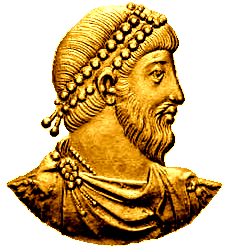
On spring of 363 ACE, the divine Emperor Julian took the route to Mount Kasios to bear witness to the early dawn and give worship and provide a sacrifice to Zeus. The sun rose, and in broad daylight, it is written by Libanius that Julian received an epiphanic vision from the God, and “saw the God and after seeing him… received advice” (Libanius, Or.18.172). It is here that Zeus, “[as] one of the immortals descended from heaven, took [Julian] by the hair, spoke to him, and after listening to [Zeus’] answer [Julian] departed” (Libanius, Or.18.172)


Bibliography

Brown, John Pairman. Israel and Hellas: Vol. 3 : The legacy of Iranian imperialism and the individual. Berlin: W. de Gruyter, 2001.

Fox, Robin Lane. Travelling Heroes: In the Epic Age of Homer. New York: Vintage Books, 2010.

Kalleres, Dayna S. “A City of Religious Pluralism and Spiritual Ambiguity.” City of Demons, 2014, 25-50. doi:10.1525/california/9780520276475.003.0001.

Libanius. Selected works: The Julianic orations. Cambridge: Harvard University Press, 1987.

Posted in Uncategorized | 2 Comments

Reconstructionism Q&A

image

Q: What is Reconstructionism?

A: A rigid and strictly historically informed methodology of reconstructing the practices and world view of the past. It is revivalism of the cultures of the European-Mediterranean cultural basin. It essentially means doing your homework for the practices you’re trying to emulate.


Q: What are the beliefs of reconstructionism?

A: Reconstructionism is merely the methodology of practice; not a form of belief. It’s not a “denomination”, and it has little to do with actual belief.  Reconstructionism is a tool; not a religion.


Q: Does reconstructionism ignore the cultural differences of the past and now?

A: Reconstructionism isn’t ignoring the cultural differences between now and antiquity, nor is it trying to live like it’s the Iron Age, nor is it even practicing the precise religion of the Iron Age. It isn’t disregarding modern ethics and values.


Q: Does reconstructionism mean spiritual stagnation?

A: No. The religions that reconstructionists follow, if practiced, will be living religions. This means there will be change and adaptation, and with that spiritual progression.


Q: Why use Reconstructionist methodology in the first place if the cultures that are being reconstructed are basically dead religions? What’s the point?

A: The cultures that reconstructionist polytheist Pagans seek the emulate may be dead, but that doesn’t mean there’s isn’t any value in their philosophical world view, nor does it mean that their understanding is somehow less valuable than those that survived destruction at the hands of evangelism, proselytization and prosecution. These questions heavily display blatant ethnocentric snobbery. The idea that what we have now, the violent Protestant overculture that has stripped the world of its resources and created a system of consumerist hyper-commodification, is somehow “better” or “more acceptable” than the traditions of our ancestors is nothing more than self-indulgent pomposity.


(Special thanks to /r/Pagan for assisting with making this)

Posted in Uncategorized | Tagged , , , , | 1 Comment